Stripelight FRT isn’t just another flashlight – it’s a breakthrough optical tool for fire, rescue, and tactical operations. Designed specifically for first responders, the Stripelight FRT projects a highly visible laser stripe that transforms the environment into usable information while preserving night vision. It helps crews instantly improve situational awareness for better problem solving, tighten team coordination, and perform faster, more efficient searches.
That laser stripe can reveal obstacles, drops, and holes, highlight safe path providing hints to navigation and to observe changes in smoke flow, density, and emerging gases– giving firefighters critical cues for hazard recognition that traditional lights simply can’t provide. At its core, Stripelight FRT is a high quality disruptive optical technology laser while providing a standard LED light source.

Stripelight is designed as more than a conventional hand-held light. Its laser-based visual guidance capability provides responders with practical, real-time situational-awareness tools that can improve navigation, team coordination, hazard recognition, and search-and-rescue effectiveness—particularly in dark, smoke-obscured, or otherwise low-visibility environments.
The Laser Stripe technology improves situational awareness and helps firefighters make crucial tactical decisions to control the fire and ensure occupant safety by predicting its behavior and the fire's potential movement.

Helps users rapidly perceive the size, layout, and boundaries of an interior space.

Projects a visible reference line that can help distinguish the edges and profiles of objects within the beam path.

Supports clearer recognition of surfaces, pathways, and environmental features in difficult lighting conditions.

Provides a visual directional reference to help maintain orientation during movement through unfamiliar or obscured areas.

Enables personnel to use a shared visual reference when directing movement, identifying locations, or communicating route information.

Helps reveal smoke movement at gaps around doors, windows, and other openings.

Assists in observing smoke escaping from cracks, seams, voids, and other potential leakage points even in day-light conditions to find source of smelling smoke.

Allows a user to sweep and assess a room or corridor quickly for changes in geometry, hazards, or points of interest.

Can be used to identify and mark a known exit path or point of egress for the team.

Helps reveal trip hazards, holes, changes in floor elevation, equipment, debris, and other obstructions.

Assists with identifying the position or movement of nearby personnel within the projected field.

Provides a visible reference point that can support a firefighter’s or rescuer’s return route, regrouping point, or emergency orientation.

Common questions about the Stripelight FRT flashlight and Laser Stripe technology.
Classic LED flashlight involves an optical lens to focus the light into a beam. The beam results in a single point of view limiting the area of sight and surroundings. The Laser light on our flashlight emits a blue Laser stripe/line, that improves situational awareness dramatically in various conditions. The Laser Stripe allows for 180 degrees viewing of the forward navigation compared to sweeping a single LED beam. The provided white LED light beam is for general use, and the optional blue laser beam stripe line is to project on objects in a smoke-filled or fire-filled structure while preserving night vision (e.g., scotopic vision). The laser is effective in identify obstacles, holes, or exits providing hints to navigation and room dimensions for situation awareness resulting in better decision making. The laser creates a reference flat plane to observe smoke flow, density, and track source. The Laser Stripe can be used to quickly scan without sweeping an area to locate victims on the floor and other firefighters wearing reflective clothing. The laser light does not disrupt night vision of eyes (e.g., scotopic vision) that have already become accustomed to the darkness.
It is well known that in smoke, the LED beam can produce a blinding wall of light back to the user like automobile lights in a fog. The image below shows on the left an LED light going through a chemical that mimics smoke. And on the right the mathematics of laser beam stripe pattern used by Stripelight through the same material.
Figure 1: Left LED light, right Laser Stripe.
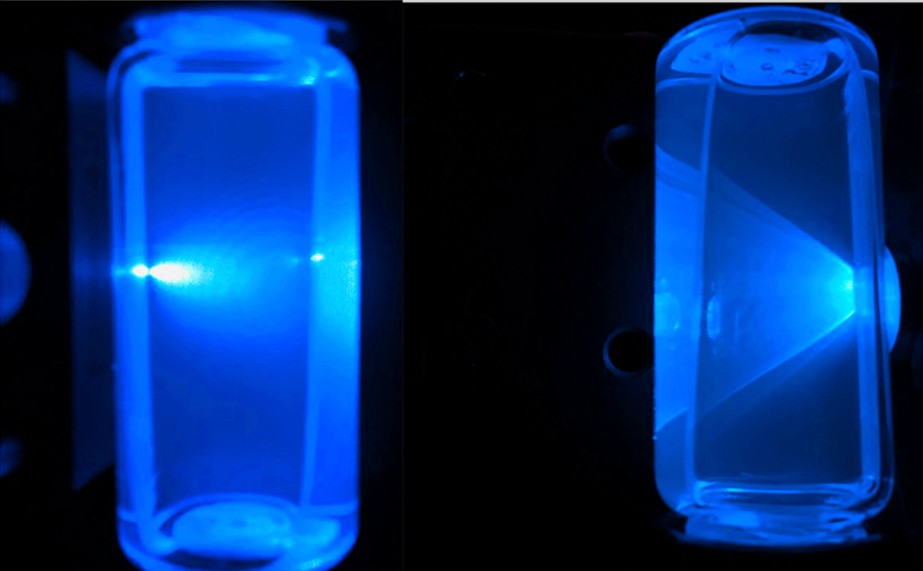
Figure 1: Left conventional LED beam vs. right Stripelight Laser Stripe in smoke chamber
Increasing LED output alone is not always the answer to visibility in smoke. A more powerful LED can intensify the glare reflected toward the user, making it harder—not easier—to interpret the surroundings. Stripelight’s approach focuses on beam package design, rather than brightness alone. The Stripelight LED-only model follows the same design philosophy. The Stripelight lens and beam profile were refined through numerous design iterations and repeated evaluations in live-fire training structures under varying smoke conditions. This development process focused on shaping useful illumination for smoke-obscured environments and rescue operations, rather than simply increasing light output.
It is not a matter of better or worse. Both light source technologies have their situational benefits and physical restrictions, especially in the environment it’s intended to be used. Therefore, Stripelight provides the best of both worlds in one device. each serving a distinct purpose. For white-light illumination, Stripelight uses a carefully developed lens and beam profile designed to support visibility during firefighting and rescue operations. The laser stripe provides a structured visual reference in identify obstacles, holes, or exits providing hints to navigation and room dimensions for situation awareness.
The FRT Stripe Line laser is designed to make air flow and room dimensions more visible, supporting navigation and scene assessment, but it is not intended to “see through” heavy smoke, and in fact no light source can truly do this because the human eye requires gaps in the smoke to perceive illumination. Although the laser beam does pass through the smoke, what can be seen from the firefighter’s position is limited by human vision and the density of the smoke. The Stripe Line can also serve as a visual beacon: by keeping the laser line on your person or gear, you can follow it back to the point of origin. Its primary role is to enhance situational awareness, offering a unique perspective on area layout and airflow that a conventional LED beam cannot provide due to the way LEDs distribute light, and a key benefit is crew coordination, since the distinctive laser line can simultaneously highlight multiple firefighters wearing fluorescent protective clothing, aiding alignment and communication in a way a single LED beam cannot achieve without constant sweeping.
The blue laser is not only used for illumination and marking, but it also serves as a means of transmitting positional information. Even in situations with extremely low visibility where teammates cannot see each other directly, they can still detect your position through the blue laser you emit, enabling quick location and effective coordination.
A perfect complement to a thermal imaging camera. The laser allows for “smoke reading” in less dense smoke, but its main advantage is the visibility of curves, stairs, alcoves, openings in floors and walls, and other potential traps awaiting the rescuer. It also provides “spatial illumination” of a wide area. However, the laser cannot penetrate dense fire gases. This is where thermal imaging comes into play.
Ideal in tight corridors such as a navy ship.


