Guidance on battery care, wireless cradle charging, and system diagnostics.
The FRT contains a rechargeable lithium-ion battery. The FRT is shipped with a battery charge no more than 30% and may be less as required by regulation. The packaging comes with a Warning Card that specifically says the first charge must be at least 12 hours (overnight). Not doing this will cause the battery 1) have less life, and 2) can affect long-term storage. When FRT is used until it stops and displays red indicator, recharging would take 3.5 hours. This charge length assumes a healthy battery that has not been fully discharged. A battery is not fully discharged in the FRT but only depleted until a minimum level. A fully discharged (dead) battery would require using the FRT until the red light flashes and then leaving the FRT for a week without the cuff on or exposure to high heat causing some battery decay. For a fully dead battery, the FRT will go through “battery recovery” which could take 24 hours. The FRT has the capability to recover a fully dead battery.
While the FRT is in the cradle charger, the green indicator light may flash on/off when the battery is known to be fully charge. Is it expected after full charge completed the green indicator light is either all on or completely off? The green indicator light may appear all on but will eventually turn off. This is an indication of being fully charged. It can flash randomly which indicates it is checking battery level. A flashing green light indicates the battery has not charged to its maximum voltage potential or is below minimum required or the battery is hot not accepting charge. As batteries age the ability to charge to maximum value declines. There is no concern for the battery flash charging, but we recommend you leave it in the charger. The charger and battery communicate with each other and that is what you are seeing for the flashing light. The battery is rated to charge to 7.4v but it will charge to a higher value if possible and the charger will try to get that higher value. Anything below that value it will continue to attempt to charge. This provides a safe tolerance range. When a battery cannot no longer charge to minimum voltage value required then the indicator will turn yellow, remain red, or turn red when turning on either LED or Laser light.
This is not a charger failure nor issue. We call this FireSmart ChargingTM. The FRT charger doesn't simply push power into the battery. It's a smart system that adjusts charging based on battery conditions. Many competing flashlight chargers supply continuous power to the battery and check its voltage. That approach isn't ideal for battery life or safety, especially when the battery is hot from recent use. Charging a hot lithium-ion battery can add heat, speed up permanent wear, and, if the battery overheats severely, create a fire risk. The Stripelight FRT avoids this through a custom battery with an onboard temperature sensor. The battery temperature sensor reports to the computer in the FRT, and the FRT talks to the cradle charger to produce the best and safest charge. If the battery temperature goes outside its permitted range, charging slows or stops until the battery cools. This protects the battery, adds safety, helps the battery last longer in operation, and extends its overall life.
This charger design matters most when the FRT comes out of a fire, because the battery inside is probably hot. The battery tells the computer, which delays or limits charging until the battery is cooler while the charger keeps checking flashing green that it is knows the battery is needs charging. That is the behavior you want, and it's a safety feature unique to the Stripelight FRT battery. Because of it, you can leave the FRT in the cradle all the time. The green light flashes while the charger checks the battery level or is charging. While the FRT sits in the cradle, the light may turn off (sleep) for an extended period and then wake to check the battery. A long flash at that point means the battery is charged to its maximum possible.
Several FRTs were placed in a cradle charger and compared for behavior of green charge light indicator. Shown below are a collection of 6 fully charged FRTs in chargers which after a few seconds then change state.
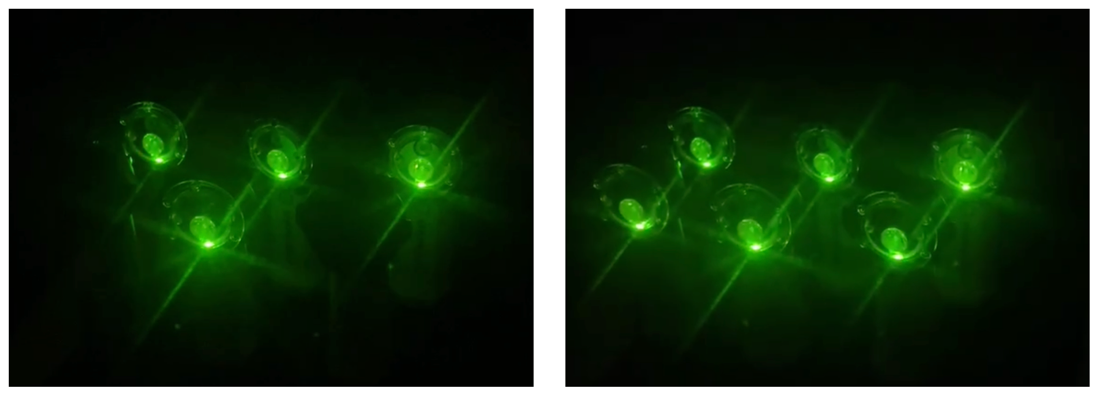
Collection of 6 fully charged FRTs in wireless cradle chargers displaying indicator light behavior
There is no concern for worry, it is the Hysteresis which is the lag between input and output of the system checks concerning changes in temperature, battery voltage, or magnetic field charger sensor. The computer in the FRT is checking not only the battery voltage but the battery temperature to avoid over charge. Hysteresis in power management refers to the phenomenon where the system's response to a change in state (e.g., power state, voltage levels) is not instantaneous and depends on the system's history. For example, when transitioning between low-power and active states, hysteresis ensures that the system doesn't switch back and forth rapidly due to small fluctuations, leading to more stable operation and efficient power management. The computer onboard is collecting sampling data and calculating if there is a need for charging. The green light indicates the system is running and checking for the health of the battery and operation is ready. Since this is a voltage measure which is analog, there are fluctuations to get an accurate level. A “constant” green light is not required to indicate fully charge and you should not wait for that to happen. Due to the analog nature of battery cells you may never see a constant green but a flash green which indicates fully charged.
The short answer is no, you cannot use a generic induction charger. These are specific for use with telephone and have different magnetic power. An induction charger has a protocol to talk to the device to ensure not overcharge and damage the device. The FRT has its own protocol and using other generic induction charger will cause the device to blow its internal fuses as a safety precaution. You can purchase the cradle charger alone with or without the AC/DC adapter.
If the Cradle Charger is working and the Stripelight FRT itself is good, the Stripelight's white LED or Laser will turn off as soon as it is placed in the powered cradle while turned on, and a known-good Stripelight in a known-good cradle will show a flashing green charge indicator.
To determine whether the wireless Cradle Charger is charging the Stripelight FRT, follow this procedure:
1. Confirm how a known-good system behaves.
Place a known good Stripelight FRT into a known working Cradle Charger that is connected to power; the Stripelight should display a flashing green light to indicate that it is charging.
2. Understand normal behavior in the cradle.
When a Cradle Charger is functioning correctly, a Stripelight FRT seated in the cradle cannot operate any of its lights, assuming the Stripelight itself has no internal fault. In other words, with a good charger and a good Stripelight, the Stripelight's lights will not operate any lights (Laser or LED) while it is in the cradle even while turning the bezel.
3. Test the suspect Cradle Charger.
Turn on the Stripelight's LED by rotating the bezel to the normal “on” position. While the LED is lit, place the Stripelight into the powered suspect Cradle Charger. If the charger is working and making proper charging contact, the Stripelight LED will turn off, indicating that charging has started and the charger is functioning.
4. Consider the possibility of a faulty Stripelight.
If the Stripelight is internally damaged, its LED may remain on even when seated in a working cradle. In that case, repeat the test using a Stripelight FRT that is known to be in good condition to confirm whether the issue is with the charger or the Stripelight.
5. Consider the possibility of a faulty charger adapter.
Change the AC/DC charger adapter with the adapter of a working charger and repeat the previous test.
The battery charging operation is analog and not digital. Therefore, there are differences in the heat generated by the Stripelight FRT while charging. We do not have control of this behavior but have designed the charger to throttle the charging based on heat temperature as well as coordinated by the internal computer in the FRT. All manufacturers have this issue with charging batteries. In the future we are testing a new type of battery not using lithium but has not been developed enough to provide the necessary power level. Once this battery is available we could see much shorter charging time, no possibility of battery catching fire, little heat generation, and longer battery life.
Differences in the heat generated by the Cradle Charger while charging the Stripelight FRT are normal. The battery-charging process is analog rather than fully digital, so heat production can vary during charging. The charger is designed to manage this behavior by automatically reducing or throttling the charging rate based on temperature. This process is also coordinated with the FRT’s internal computer to help protect the battery and charging system.
Heat variation during battery charging is common across manufacturers and is not unique to the Stripelight FRT. While we cannot eliminate all heat generated during charging, the system is designed to monitor and control it safely.
We are also evaluating an alternative battery technology that does not use lithium. This technology is still under development and is not yet capable of delivering the power level required for the Stripelight FRT. If it becomes commercially viable, it could potentially offer shorter charging times, lower heat generation, longer battery life, and a eliminate risk of fire.

